
3D renderings of e-commerce fulfillment centers offer architects and developers a clear and detailed visualization of facility layouts, equipment placement, and workflow efficiency before construction begins. These realistic models streamline the planning process by allowing stakeholders to identify design challenges, optimize spatial arrangements, and make faster, more informed decisions.
Seeing the Big Picture: Why 3D Visualization is a Game-Changer in Fulfillment Center Planning
3D visualization is a game-changer in fulfillment center planning, providing a comprehensive view that bridges gaps between architects, developers, and stakeholders. This holistic perspective provided by 3D is crucial in ensuring that every aspect of the distribution center, including various visual elements such as vertical space utilization and labor productivity, as well as vast amounts of fulfillment operations, is optimized for maximum efficiency and understood by all parties involved in the decision-making process.
Visual representations transform complex architectural plans into easily understandable 3D images, enhancing comprehension of the fulfillment center’s functionality and appearance. Visualizing warehouse projects in 3D enables architects and developers to make informed decisions on optimizing this space for improved fulfillment performance.

Warehouse logistics building architecture, France / Inventory management 3D rendering crafted by RNDR
Speeding Up Site Analysis with 3D Design Visualization of Fulfillment Centers
The site analysis phase is crucial to planning any fulfillment center. Traditionally, this process can be time-consuming and prone to errors. However, 3D design visualization has transformed this aspect by enabling faster and more accurate assessments.
Logistic buildings, visualization tools, and 3D services enable architects and developers to quickly identify site constraints and opportunities. This allows for a more efficient allocation of resources and ensures that the design is optimized from the outset.
Visualizing relevant design aspects of e-commerce business buildings enables stakeholders to make informed decisions, enhancing operational efficiency and fulfillment performance.
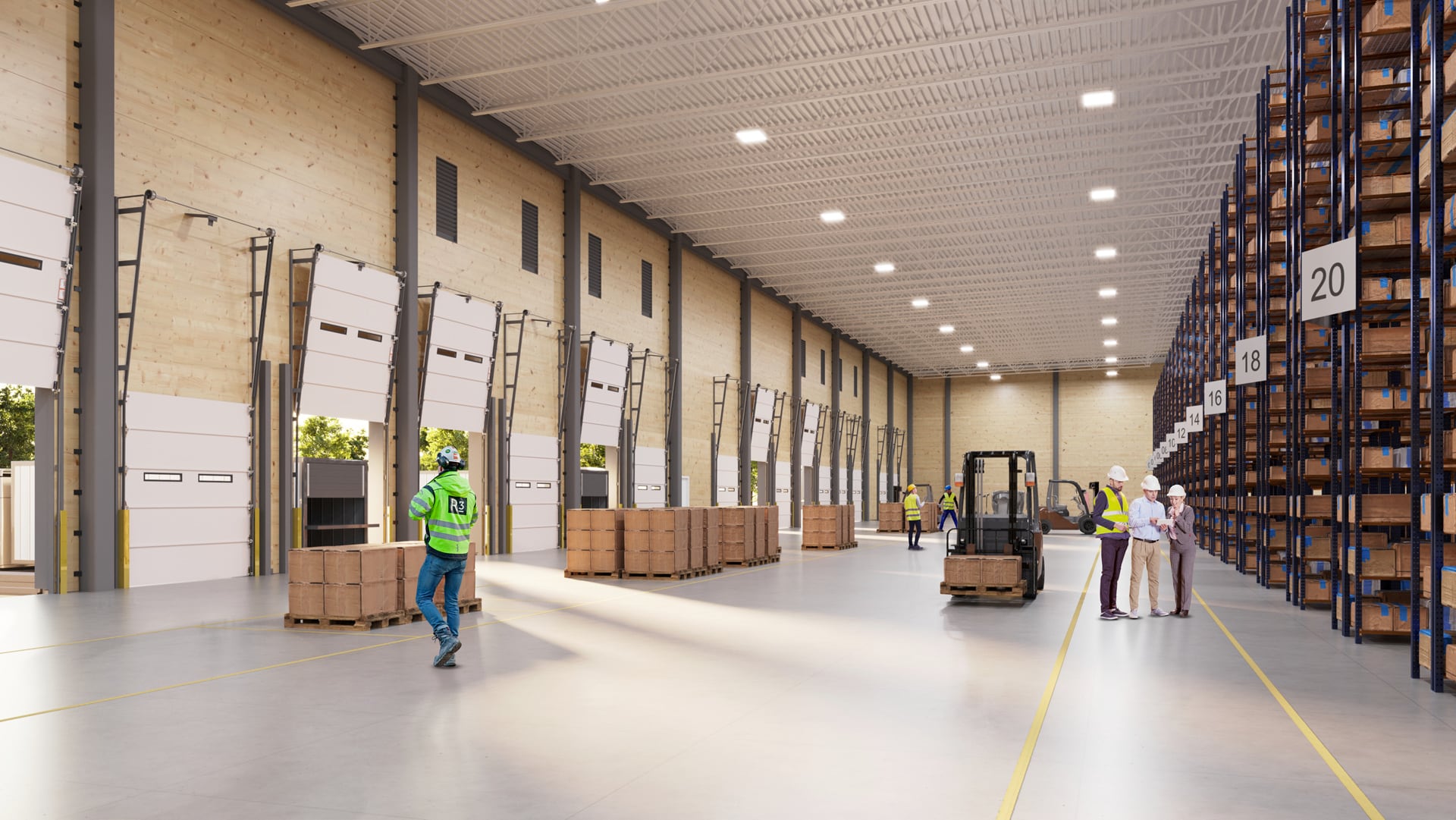
Warehouse design of logistics commercial building, made of mass timber in Texas, USA / Architects and designers: Katerra / E-commerce fulfillment warehouse floor rendering crafted by RNDR
Design Iterations Made Easy: Experiment Without Risk with 3D Rendering Services for E-Commerce Logistics Hubs
One of the significant advantages of commercial architectural 3D rendering services is the ability to experiment with design iterations without the risk. In the fast-paced world of e-commerce, continuous improvement is essential, and 3D rendering offers the ideal platform for this.
Architects can quickly test various layout options and optimize spaces for better operational efficiency before committing to a final design. This flexibility is particularly beneficial in e-commerce fulfillment centers, where efficient and cost-effective solutions are needed. By visualizing different scenarios, architects can identify the most effective design, ensuring that the distribution center is optimized for peak performance.
The concept of continuous improvement is at the heart of 3D rendering services. Experimenting with different designs enables architects to make data-driven decisions that enhance e-commerce fulfillment and directly improve operations within the logistics hubs. This not only improves delivery times but also reduces risks associated with design changes.
Furthermore, 3D rendering services offer a cost-effective solution for e-commerce businesses. Visualizing the design before construction helps businesses avoid costly mistakes and ensures the final design meets their needs. This approach also allows for better planning and resource allocation, ultimately enhancing the efficiency of the distribution center.
In essence, 3D rendering services make design iterations easy and risk-free, providing a powerful tool for architects and developers in the planning of e-commerce logistics hubs.

Warehouse logistics building architecture, Garonor Batiment, France / E-commerce fulfillment hub rendering created by RNDR
Early Clash Detection: Prevent Costly Mistakes Before Construction of the Fulfillment Center Starts
In the planning and construction of fulfillment centers, early detection of clashes is a crucial factor that can save significant time and costs. 3D rendering services play a vital role in identifying design conflicts between structural, mechanical, and logistics systems.
Visualizing the entire design in 3D allows architects and developers to identify potential clashes early in the planning process. This enables timely adjustments to ensure the final design is free from conflicts and optimized for operational efficiency, with improved operations through early detection of clashes. By detecting clashes early, businesses can reduce costs by preventing expensive rework and delays that often occur when conflicts are discovered later in the construction process.
Streamlining Operations and Logistics Through 3D Visualization
Data visualization is a transformative force in streamlining operations and logistics within e-commerce fulfillment centers. By converting complex data into intuitive visual representations, businesses gain a better understanding of their supply chain and warehouse processes. This clarity enables warehouse managers to quickly identify bottlenecks, optimize warehouse design, and make data-driven adjustments that enhance operational efficiency.

Warehouse logistics building architecture, France / E-commerce fulfillment hub rendering created by RNDR
Stakeholder Buy-In: Winning Approvals with 3D Rendering Presentations of E-Commerce Fulfillment Center
Gaining stakeholder buy-in is essential in the planning and construction of e-commerce fulfillment centers. 3D rendering presentations play a pivotal role in this process by:
- Transforming complex plans into compelling stories.
- Providing a clear and realistic representation of the project, which makes it easier for stakeholders to understand and approve the design.
- Improving client satisfaction.
- Enhancing customer engagement and decision-making.
- Allowing architects to effectively communicate their vision and secure necessary approvals by presenting the design in a visually appealing manner.
Moreover, 3D rendering presentations help meet customer expectations and identify product preferences. By visualizing the design, businesses can make informed decisions that align with customer behavior and preferences. Understanding customers and tailoring fulfillment center designs to better serve their needs is crucial for delivering a personalized and seamless experience. This ultimately leads to greater client satisfaction and a more successful e-commerce business.
In addition, 3D rendering presentations facilitate better decision-making by providing a clear and detailed view of the project. This ensures that all stakeholders are aligned and that the final design meets the needs of the business. Gaining stakeholder buy-in ensures a smooth planning and construction process, leading to a more efficient and effective distribution center.
Sustainability Planning: Visualizing Green Building Strategies of E-Commerce Fulfillment Centers
In today’s world, sustainable growth is a key consideration in the planning and construction of fulfillment centers. 3D visualization plays a key role in supporting eco-friendly designs and energy-efficient systems.
Visualizing green building strategies ensures that architects and developers design the distribution center with sustainability in mind. This includes integrating energy-efficient systems, optimizing space utilization, and incorporating eco-friendly materials. Visualization tools allow for a comprehensive view of these elements, ensuring that the final design aligns with sustainability goals.

Warehouse logistics building, France / 3D rendering crafted by RNDR
Conclusion: 3D Rendering as the Ultimate Planning Accelerator for Logistics Hubs
3D rendering services have emerged as a powerful catalyst in the planning modern fulfillment centers. By enhancing visualization and streamlining decision-making, they enable the optimization of every aspect of logistics hubs for peak efficiency and performance.
These visualizations offer stakeholders a clear and realistic representation of the project, enhancing communication and ensuring alignment with design objectives. Early identification of potential design flaws reduces costly revisions and minimizes construction delays.
Incorporating detailed architectural elements, 3D renderings also improve accuracy and support layout optimization, ensuring the final design aligns with operational requirements. Ultimately, 3D rendering is an indispensable tool that accelerates planning, enhances accuracy, and contributes to the overall success of e-commerce logistics hubs.
Looking for Expertise in Logistics Hubs Visualization Services?
Contact us by clicking below and submit your project details for professional support.
