
Property visualisation sells homes faster and at better prices because it lets potential clients to explore properties and see their future lifestyle, not a layout. What is more interesting, and it has less to do with technology than most people in our industry admit.
I run a boutique European 3D rendering studio with a team of a few, and after years of working with architects, developers, and real estate agencies on projects across four continents, I keep seeing the same pattern. Two developments, similar location, similar price point, similar quality of architecture. One sells out before construction begins. The other sits on the market. The difference is almost never the building. It is how the building was presented to the people who were supposed to fall in love with it.
This article is written for architects and real estate developers who already use CGI in their property marketing and suspect it could be doing more. I want to walk through what separates a technically correct render from a good render that closes deals, why lifestyle should sit at the center of your visuals, and what the numbers say about all of it.
What Is Property Visualisation in Modern Real Estate Marketing?
Property visualisation means creating digital images, animations, and interactive experiences of a property, usually before it exists. A development team hands over drawings, material specs, and a site plan. A real estate visualization studio turns those into architectural images that a buyer can react to.
That is the textbook definition. In practice, real estate visualization has quietly become the sales infrastructure of the industry. Buyers now shortlist properties from a screen, often in another city or country, long before they visit anything. An agent in Tampa can walk an investor in Ottawa through an apartment that will not exist for two more years. Remote sales like this only work when the visuals carry the full weight of the presentation.
The data backs this up. Zillow’s 2025 Consumer Housing Trends Report found that 33% of buyers rank floor plans as the most important listing feature, with high-resolution photos at 26% and 3D tours at 20%. Written descriptions came in at 15%. Buyers are telling us, quite plainly, that they decide with their eyes. Lifestyle, detailed view 3D visualization also shortens sales timelines because it removes ambiguity. When a prospective buyer sees exactly how the morning light hits the kitchen island, there is one less question standing between them and an offer.
Stop selling square footage. Start selling Sunday mornings. Immersive renders that put a buyer inside the life, not just the layout.
Malgo, CEO of RNDR

Key Features of Lifestyle-Focused Property Visualisation and Rendering Services
Most rendering output looks the same. Blue sky, empty rooms, a building presented from an angle no human will ever stand at. Technically clean, emotionally silent.
Lifestyle-focused visualization starts from a different question. Not “what does this building look like?” but “what does a Tuesday evening feel like here?” On top of a photorealistic base, we add a storytelling layer: a specific time of day, a season, traces of the people who live there. A coat over a chair. Steam rising from a cup on the balcony rail. A dog waiting by the door. Small things, deliberately placed, that turn an architectural image into a scene from someone’s future.
Here is how the two approaches compare in practice:
Aspect |
Traditional Rendering |
Lifestyle-Focused Rendering |
| Primary goal and key role | Document the architecture accurately, design elements and furniture arrangements | Make the buyer imagine living there, evoke positive emotions and boost buyer confidence |
| Interiors | Empty or generically staged rooms | Rooms mid-use, with narrative details and personal traces |
| Lighting | Neutral midday, technically correct | Chosen for mood: golden hour, rainy evening, first snow |
| People | Cut-out figures for scale | Characters matched to real buyer personas |
| Exteriors | Building isolated from context | Streetscape visualization with curab appeal and neighborhood life around it |
| Landscape | Shows lanscape plans and vegatation | Presents the contact with nature and how landscape shapes everyday outdoor living |
| What the buyer sees | A product | A version of their own life |
| Typical marketing result | Informs | Converts |
Both start from the same drawings. Only one of them makes someone call the sales office.
Living at Kop West in the Netherlands / Interior animation made by RNDR
Why Every Property Visualizer Should Focus on Lifestyle Instead of Architecture Alone
Here is an uncomfortable truth about our craft. The render that wins an architecture award and the render that sells an apartment are usually two different images. Architects are trained to read plans, proportions, and materiality. Buyers are not. A buyer scrolling forty listings on a Sunday night gives each image about two seconds, and in those two seconds they are not evaluating the facade rhythm. They are asking one question: could that be my life?
Architecture is the reason a project deserves attention. Lifestyle is the reason it gets any.
Designing Real Estate 3D Renderings For Emotions
People do not buy square meters. They’re buying the feeling of Sunday breakfast in that kitchen. The image of their kids running around that garden. Advertising research backs this up too, campaigns built around emotional appeal tend to beat purely rational ones, with some studies pointing to a sales lift near 23%. And real estate is probably the most emotional purchase most people will ever make in their life, yet somehow so much property marketing still reads like a spec sheet.
A good render doesn’t happen by accident. Someone designed it to make you feel something on purpose. Lighting, composition, weather, the story implied by the objects in the room: all of it is chosen to make the buyer feel something specific. That feeling is what they remember three listings later.
Showcasing Spaces In Use
Most people skip that assignment entirely. Show the same room mid dinner party instead, chairs pushed back, dessert plates still waiting to be cleared, and the space explains itself without anyone having to think about it. Scale, function, atmosphere, all of it lands in a single glance. No caption required.
That same idea holds at every zoom level. Interior rendering answers a pretty basic question: how would we actually live in this room? Streetscape visualization answers a different one, the one buyers ask the second they picture themselves outside: what happens the moment I step out my front door?. And aerial rendering, the CGI equivalent of drone photography, answers the question buyers rarely voice but always weigh: what is around this place? Aerial rendering and bird’s-eye-view images drop a future project into its real surroundings, so a buyer suddenly understands the walk to the park, what the view actually looks like from the sixth floor, how far it really is to the tram stop. Buyers purchase the neighborhood as much as the unit, so show them the neighborhood in use too.
Appealing To Different Buyer Personas
One CGI set can speak to several audiences if you plan it that way. The same apartment visualized as a young couple’s first home reads differently than when it is dressed for an empty-nester downsizing from a house. Agents marketing to international buyers who will never attend an in-person viewing lean on this hard. When the visuals are the viewing, the visuals had better be persuasive.
A building has one design but many futures, and smart property marketing renders more than one of them. The same two-bedroom apartment can be staged as a young couple’s first home, all plants and vinyl records, or as the calm, pared-back retreat of an empty-nester trading a house for walkable city life. Same walls. Completely different people falling in love with the place.
This matters most when the buyer will never actually set foot in a showroom. Agents working with international buyers and remote investors are relying on the visuals to carry the entire viewing, from first impression all the way to final decision. And if a persona can’t find themselves anywhere in that image set, they don’t say anything. They just move on to the next listing, and you never find out why.
The floor plan answers “where’s the bathroom.” It doesn’t answer “could I be happy here.” That second question is the one real estate 3D visualization actually sells.
Malgo, CEO of RNDR
How Property Visualisation Contributes to Faster Sales in Real Estate Agents Life and in the Modern Sales Process
Speed is where real estate visualization stops being a marketing expense and becomes a financial instrument. Every month a unit sits unsold costs the developer carrying costs, and costs the agent momentum.
Attracting Qualified Buyers Earlier
Strong visuals filter the audience before anyone picks up the phone. Buyers who reach out after seeing detailed interior and exterior rendering already understand the product, so conversations start further down the funnel. Agents spend less time explaining and more time closing deals.
Shortening The Decision Cycle in Real Estate Industry
Real estate professionals consistently show properties marketed with 3D visualization sell up to 30% faster. The mechanism is simple: uncertainty is what slows buyers down, and good visuals remove uncertainty one image at a time.
Supporting Off-Plan And New Construction Sales of Real Estate Developments
This is where real estate visualization earns its keep most obviously. High quality renderings let developers showcase properties and open sales before construction begins, sometimes years before. Virtual staging does similar work for finished but vacant spaces, at a fraction of the cost of physical furniture.
ECI Group, a multifamily developer in the US, is a useful example. Their marketing operations lead has described how immersive 3D tours let them pre-lease developments while the site was still concrete and scaffolding, selling the lifestyle of the finished community rather than the construction site prospects would otherwise see. That is the whole argument in one case: the visuals carried the sales process through the period when there was nothing physical to show.
Selling At Better Prices
Faster is one thing. Higher is another. Listings supported by 3D visualization have been shown to sell for up to 9% more. Impressive, right? But also very simple: perceived value follows presentation, and buyers pay for what they can vividly imagine owning.

Living in Sutton Courtenay in United Kingdom / Residential rendering crafted by RNDR
How Lifestyle-Focused Property Visualisation Influences Decision Making
The moment of decision is where lifestyle rendering does its quietest, most important work.
Creating Emotional Connections With Buyers
Buyers hesitate for one simple reason: they can’t picture themselves in the space yet. Lifestyle CGI exists to answer that unspoken question before it even gets asked out loud. Not with more information, but with a feeling the buyer recognizes as their own life, just waiting for them to move in.
Helping Prospects Imagine Everyday Living
Buyers have many questions in their heads. And rendering role is to address them.
- Will my furniture fit? Visualization tools allow buyers test that themselves, arranging pieces inside the exact room dimensions instead of guessing.
- Which finishes do I actually want? Customizable 3D models let them swap flooring, cabinetry, and configurations until the apartment starts to feel less like a listing and more like theirs. Each small tweak, each thing they change, pulls them a little further in. By the time someone has rearranged the virtual living room twice, they’ve usually stopped browsing and started deciding.
Reducing Uncertainty During Decision Making
This matters even more for unfinished properties. A hole in the ground gives a buyer nothing to hold onto, nothing to attach any feeling to at all. But a property rendering with identity, with warmth, with some believable version of a life happening inside it, gives potential buyer confidence something solid to stand on. In our experience, that’s usually the difference between a reserved unit and someone saying “I’ll think about it” and never calling back. That is why a good rendering is powerful tool for presenting and selling projects.
Animations, Virtual Tours and Interactive 3D Experiences That Increase Buyer Engagement
Still images open the door. Motion invites people inside.
Listings with 3D tours generate up to 87% more views than traditional ones, and some agents report tours helping close sales within weeks. Letting people explore a property at their own pace, from their own couch, does something a photo gallery just can’t. It builds familiarity, the kind that comes from actually moving through a space rather than flipping through a slideshow of it. By the time buyers show up for the physical viewing, if there even is one, they already feel like they’ve been there before.
Interactive site plans push that even further. A prospect can click through a master plan on their own time, pick a building, poke around individual apartments, check orientation and views, browse the amenities, all without an agent standing over their shoulder. For large developments this works as a self-service sales gallery that never closes. Interactive platforms that let users explore floor plans and the surrounding neighborhood do the qualifying work overnight, and the sales team wakes up to warmer leads.
Real estate animation sits somewhere between the two: a two-minute film that walks the viewer from the street, through the lobby, into a sunlit apartment, and out onto the terrace at dusk. It is immersive experience. Done well, it is the closest thing property marketing has to a movie trailer.
Living at Kop West in the Netherlands / Exterior and landscape architecture animation made by RNDR
How Real Estate Agents Use Property 3D Visualisation to Win More Clients
Agents have a second audience nobody talks about enough: the sellers and developers deciding which agency gets the listing in the first place.
Better Property Presentations
Walk into a pitch with cinematic visuals of a comparable project and you’ve made your case before you’ve said a word. Developers want a partner who can present their vision at the level it actually deserves, and agencies that invest in real architectural CGI tend to win mandates over the ones still leaning on stock photography and flat floor plans.
Faster Communication With Buyers
Visuals speed up the day-to-day too, not just the big pitch. Instead of describing a layout over the phone and hoping the buyer can picture it, an agent just sends a detailed view. Instead of booking a site visit for a lead who’s only half interested, they share a tour link and let the buyer’s own curiosity do the qualifying. No wasted afternoons, no awkward “so what did you think” calls with someone who was never really serious.
Building Trust Through Realistic Visuals
Because the images set honest expectations from the start, buyers who do show up for a viewing rarely feel let down or misled by what they saw online. That kind of consistency adds up. Trust compounds over time, and compounding trust is usually what turns one closed deal into three more referrals down the line.
Anyone can show a kitchen. Few can show what it feels like to cook there on a Sunday with the windows open. That’s immersive rendering done right.
Malgo, CEO of RNDR
Competitive Advantage: Why Real Estate Developers, Architects and Professionals Invest in Advanced Visualization Techniques
In crowded markets, sameness is expensive. When every new residential project publishes the same bright, empty, interchangeable renders, buyers cannot tell one development from another, so they compare on the only variable left: price. That is a race nobody wins.
Distinctive, story-driven visuals break that pattern. They give a project an identity buyers remember, and memorability shows up directly in marketing metrics: longer time on listing pages, more shares, more inquiries per impression. Marketing ROI improves not because you spent more, but because every asset works harder. A single strong set of visuals feeds the website, the sales gallery, the brochures, the social campaigns, and the investor deck for the next project.
Investors notice too. A development presented with conviction and craft reads as a development managed with conviction and craft. Fair or not, the quality of your images is treated as a proxy for the quality of your project.
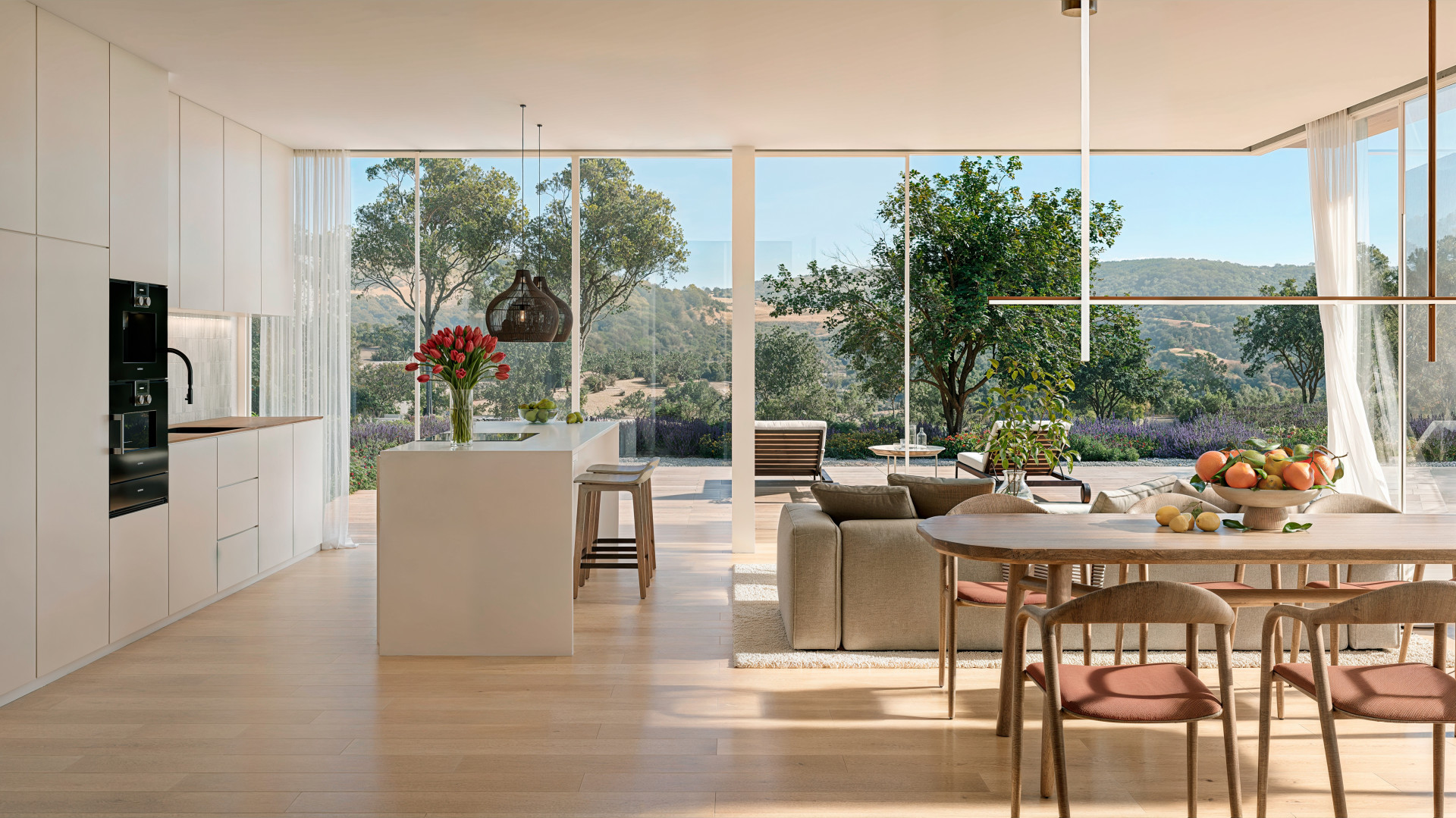
Silves Hills Villas, Algarve, Portugal / Interior property rendering creadted by RNDR
Sell The Lifestyle, Not The Floor Plan
If you take one thing from this article, take this: buyers do not fall in love with buildings. They fall in love with the version of themselves that lives in them. Property visualisation, done with intention, is how you introduce those two parties before a single wall goes up.
The technical bar for photorealistic style has been met across the industry. What separates projects now is the layer on top: the story, the mood, the specific human life implied in every frame. That layer is not decoration. It is the part that does the vision selling.
So look at your current marketing visuals and ask an honest question. Do they document your architecture, or do they make someone want to move in? If it is the former, the good news is that the same drawings can produce something far more persuasive. It just takes a team that thinks about who the buyer sees when they look at the image: themselves.
If you would like to talk through how a lifestyle-driven approach could work for your next project, get in touch with us. We are always happy to look at a set of plans and create the life inside them.
Frequently Asked Questions – FAQ
What is the difference between architectural rendering and lifestyle-focused property visualisation?
Architectural rendering documents a building accurately: correct proportions, correct materials, correct light. Lifestyle-focused visualisation starts from the same accurate model but adds a layer of story on top, a specific moment, a specific mood, small signs of an identity and life already being lived there. One shows you a building. The other lets you imagine yourself inside it.
Does real estate 3D visualization actually help sell properties faster?
The data says yes, and by a fair margin. Listings marketed with 3D visualisation have been shown to sell up to 30% faster than those without it, largely because good visuals remove the guesswork that normally slows buyers down. Fewer unanswered questions usually means a shorter path to an offer.
Is property visualisation only useful for off-plan or new construction projects?
Not at all. It’s most obviously valuable there, since there’s nothing physical to show a buyer yet, but it works just as well for finished properties. Virtual staging can dress an empty room for a fraction of what physical staging costs, and lifestyle CGI can make even a fully built, photographed listing feel warmer and more specific than a standard photo ever could.
Why does emotional, lifestyle-driven CGI outperform standard photorealistic 3D rendering services?
Because buyers rarely decide with a spreadsheet in hand. Most people buy a home on how it makes them feel first, then justify the decision afterward with logic. A technically flawless render can still leave someone cold if there’s no story in it. A lifestyle-driven image gives them something to feel before they’ve even finished scrolling past it.