
If you work in architecture, development, interior design, or construction, and you’ve ever felt that the images of your project didn’t quite do it justice, this article is for you. Marketing directors trying to find the right visual language for a campaign will recognize the problem too.
We look at architectural storytelling and why lifestyle renderings go further than photorealistic images, not just showing a building, but making people want to be in it, long before the first brick is laid.
Why We Love Working at the Intersection of Architectural Photography, Interior Design Photography, and Drone Video
There’s something that happens when you get the image right. Not technically right, but emotionally right. The kind of picture where a developer sends it to the team with no comment because none is needed, or a marketing director uses it everywhere because it just works on every format and audience. We love working toward that moment. It starts with genuinely understanding the project, the site, the people it’s being built for, and then finding the right format to make that visible, whether that’s a lifestyle rendering, a reference drawn from interior design photographs, or drone video and photos that places the building honestly in its landscape. The format follows the story, not the other way around.
What makes a building more than just a structure? That question sits at the center of everything we do. When we start work on a project, walls and windows aren’t the first thing on our minds. The story the space needs to tell comes first, and how to make that story visible before a single thing gets constructed.
Architectural storytelling isn’t a framing method for us. It’s the actual craft and creativity power we use. Every rendering we create is built around a narrative: who lives here, who works here, what does a Tuesday morning feel like in this courtyard, what does light do to this facade at dusk. The geometry matters. But the life inside the geometry is what moves people. This is what architectural storytelling specializes in.
THE BEST ARCHITECTURAL PROJECTS AREN’T EXPLAINED. THEY’RE FELT. LET’S BUILD THE VISUALS THAT DO THAT WORK.
Malgo, CEO of RNDR

Photorealistic Is a Starting Point. Lifestyle Is the Destination
There’s a real difference between photorealistic rendering and lifestyle rendering, and we think about it on every project. Photorealism is a technical achievement presenting finished product. Lifestyle is a point of view. A professional photorealistic image can be flawless and still feel completely empty, a building with no soul, no sense of who it’s for, no suggestion of the story it contains.
What we specialize in is the other thing. Images where you can almost smell the coffee, feel the warmth of afternoon light on natural timber, sense that people actually live here. The Sydney Opera House doesn’t move people because it’s geometrically accurate. It moves people because it has character, a clear identity, an unmistakable sense of place. That’s the target with every project we take on.
Architecture communicates whether architects intend it to or not. Buildings reflect community values, cultural identity, and the priorities of the people who built them. Our job is to make that communication deliberate, to create images that capture what the architect and developer actually meant and present it to the world in a way that lands.

1st prize architectural competition / Azieweg in Haarlem, Netherlands / Real estate developer and architectural firms: VORM x Bosch Slabbers x Geurst & Schulze Architecten / 3D real estate renderings produced by RNDR
Materials Are Vocabulary, Not Decoration
Interior designers know this better than almost anyone: materials aren’t finishes, they’re how a space speaks. The warmth of timber in a hallway. The particular weight of stone underfoot. The way afternoon light catches a textured plaster wall differently than a smooth one. These aren’t aesthetic choices sitting on top of the design, they are the design, and they’re doing narrative work constantly.
When we start a project, the material palette is one of the first conversations we want to have. Not just what’s specified but why. What does this space want to feel like? Who is going to be in it and what do they need from it? The preference for natural over synthetic materials, the relationship between color and texture, the way a surface absorbs or reflects light, all of this shapes how the story evolves and lands emotionally.
Interior design photography has been a constant reference point for how we approach this. The photographers who are really good at it understand that a room has to feel inhabited to feel true. A shoot where everything is too perfect, too still, too composed reads as staged rather than lived in. We carry that instinct into our 3D work. The warmth, the imperfection, the sense that someone just stepped out of frame, that’s what makes an image feel real in the way that actually matters.
EVERY SPACE HAS A NARRATIVE. WE FIND IT, FRAME IT, AND HAND IT TO YOUR MARKETING TEAM READY TO USE.
Malgo, CEO of RNDR
The Floor Plan Is Where the Story Begins, Not Where It Ends
Architects know that a floor plan is a narrative map. The progression from entrance to living space, from ground floor to third floor, from private rooms to shared ones, that’s a sequence, and sequences tell stories. Each level builds on the last, the way scenes build in a film or chapters in a book. Architects craft that progression deliberately: varying scale, brightness, warmth, openness. Balconies and terraces become pauses, moments to catch your breath and look at the world before continuing.
What we try to capture in our renderings is that sense of movement through a space, not just the space itself. A site plan gives context: this building in its neighborhood, this property in its landscape. A lifestyle rendering gives feeling: this is what it’s like to actually be here. Those are different things, and both matter.
Drone video and photo used in renderings have become a powerful tool for the context piece, showing how a development sits in its surroundings, how it relates to the street, the park, the water. Things you simply cannot communicate in a still image from ground level. When presenting a project to audiences who don’t read technical drawings, that aerial perspective can do more work than anything else in the deck. We love working in this format precisely because it forces a different kind of thinking about a project, about scale, about landscape, about the relationship between a building and everything around it.
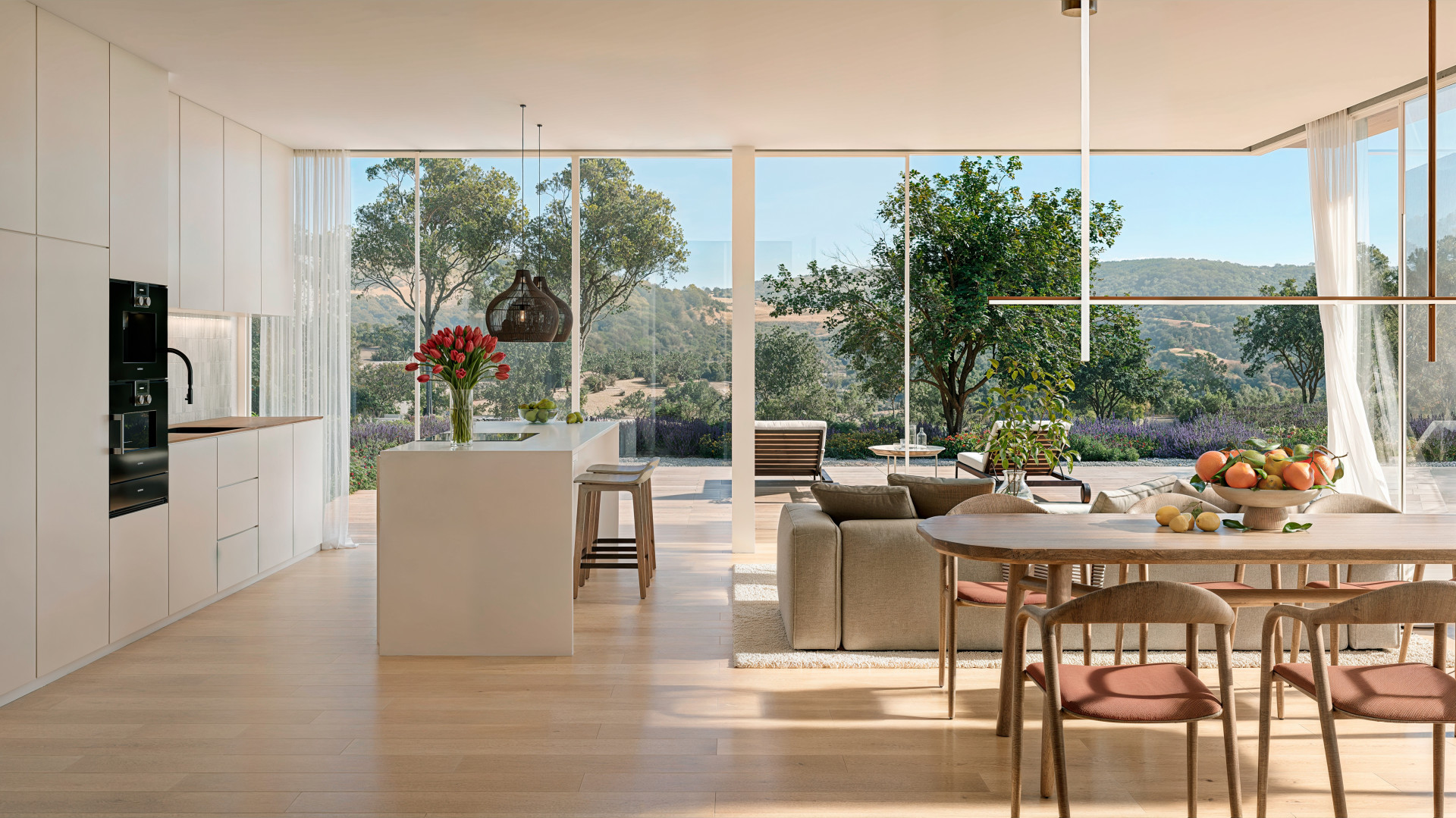
Luxury villas in Silves Hills in Algarve, Portugal / Real estate developer: Invego / Architectural storytelling 3D rendering services provided by RNDR
Design Concepts Are Living Chapters, Not Fixed Documents
One thing we love working on is early-stage visual development, when the ideas are still moving forward and backward. Conceptual diagrams, visual explorations, storyboards for how a space might feel. These aren’t polished deliverables, they’re thinking tools. And good visual communication at this stage can genuinely change where a project goes.
BIG’s Mountain Dwellings is a useful example from the wider architecture world: the conceptual diagrams for that project made a complex, innovative idea legible to people who weren’t architects. They didn’t simplify the concept. They translated it. That’s what we’re trying to do when we help architects present ideas to clients or competition juries before the design is resolved, to find the images that make the vision understandable without flattening it.
Each iteration of a concept adds depth. Revising and developing visual ideas isn’t just documentation, it’s part of how the architecture itself gets better. We do our best creative work when clients understand that and involve us in this conversation, rather than waiting until everything is locked to commission the final pictures.
The Architect As Storyteller, And Our Role In That
The best architects use symbolism, metaphor, and proportion in ways their clients will feel but rarely consciously notice. Architectural storytelling can involve local historians and community artists. Architectural visualizations can structure designs like a thesis. The way a threshold marks a transition. The relationship between a public and a private zone. The view that opens up exactly when you need a moment of relief. These are narrative decisions, and they require the same empathy that any good storytelling requires: a genuine understanding of the audience and what the story needs to do for them.
Our role is to support that, to help architects and developers communicate the ideas behind the construction, not just the construction itself. That means getting under the skin of the design business. Understanding what challenges it solved, what community it serves, what values it reflects. The images we’re most proud of are the ones where you can feel all of that before you’ve even started to analyze what you’re looking at.
We think of this as a collaborative process with sharing great feedback, not a service bolted onto the end of one. The difference in output is significant.

1st award architectural tender / Waterfront in Harderwijk, Netherlands / Clients: Molenaar & Co x LAP Landscape & Urban Design / Collaboration: Trebbe x BPD Gebiedsontwikkeling x Sweco Architects x Peutz B.V. x Witteveenbos x New Horizon Urban Minning x NL Green Label / Architectural rendering created by RNDR
AI Is a Powerful Tool. The Story Behind It Still Needs To Be Human
AI is moving through the architectural storytelling and rendering world fast. The images it can produce are improving, and the design process is changing as a result. What AI doesn’t have is understanding of a specific client, a specific site, a specific community, and what a project needs to mean to the people it’s being built for. That judgment, that creative conversation between a studio and the people who commissioned the work, is where the real storytelling happens. A powerful tool still needs someone who knows what story to tell with it.
Here’s the table:
AI Renderings |
Storytelling Renderings |
|
| Speed | Fast, generated in minutes | Considered process, takes time to get right |
| Output | High volume, many options quickly | Selective, every image has a purpose |
| Emotional impact | Technically capable, emotionally generic | Built around atmosphere, feeling, and lived experience |
| Project identity | Could be any project, anywhere | Specific to this site, this community, this brief |
| Client values | Not considered | Central to every creative decision |
| Material storytelling | Renders materials accurately | Understands what materials communicate emotionally |
| Human presence | Often staged or absent | People belong in the scene, life feels real |
| Narrative | None by default | The starting point, not an afterthought |
| Best used for | Early exploration, quick iterations, volume work | Competitions, marketing campaigns, sales launches, investor decks |
| What it tells the viewer | This is what the building looks like | This is what it feels like to be here |
| Creative collaboration | Prompt in, image out | Brief, research, dialogue, refinement |
| Memorability | Easily forgotten | The image a client saves and keeps coming back to |
How Spaces Make People Feel, And How We Capture That
Natural light can transform a room in ways no amount of clever furniture arrangement can fake. The relationship between ceiling height and floor area creates feelings of openness or intimacy that operate on people before they’re consciously aware of it. Flexible, open layouts give a sense of control and connection. These are real phenomena, architects use them as tools, and our job is to make those tools visible in the images we create.
For lifestyle renderings, this means making judgment calls that go beyond technical accuracy. What time of day serves this story? What are the people in this scene doing, and does that feel true to who this building is for? What do we include and, just as importantly, what do we leave out? A well-composed lifestyle image gives you the atmosphere of a space before you’ve registered the architecture. If you’re reading the architecture first, something is off.
This is where the distinction between photorealistic and lifestyle rendering becomes most clear. Photorealism asks: does this look accurate? Lifestyle asks: does this feel true? Both are legitimate questions. They serve different moments in how a project gets presented to the world.
YOUR PROJECT HAS A STORY. WE HELP YOU TELL IT BEFORE THE GROUND BREAKS.
Malgo, CEO of RNDR
Building For Real People, Not Abstract Users
The end user has to be present in the design process even when they’re not in the room. An architect who genuinely understands who is going to live in a space, what their mornings look like, how they use the kitchen on a weeknight, whether the kids do homework at the dining table, makes better decisions. And when we understand who a building is for, we make better images.
This is what creates the sense that a property isn’t just generically desirable but actually right for you, specifically. When someone looks at a render and thinks “I could live here,” that’s the story working. That’s architectural storytelling doing its job. Construction companies, interior designers, marketing directors, developers: everyone in the chain is ultimately trying to create that moment of recognition. Renderings are one of the main places it either happens or it doesn’t.

Natural History Museum / Storytelling interior 3D rendering created by RNDR
The Tools: How We Bring These Stories to Life
Sketches establish the first ideas. Conceptual diagrams and storyboards make them communicable. 3D lifestyle renderings bring atmosphere to life. Drone video and animations adds movement, context, and scale. Each format serves a different moment and a different audience.
We don’t think of these as separate services so much as different chapters in a project’s visual story. An architect presenting to a competition jury needs different images than a developer building a website to sell apartments off-plan. A marketing director preparing a campaign needs different material than a construction company presenting to a planning committee. Understanding which story needs telling, to which audience, and in which format, that’s where the real creative work happens.
We’re genuinely excited by projects that give us something to dig into. The more specific the brief, the better the work. Generic aspirations produce generic images. Strong identity, in the architecture and in the brief, produces pictures that people actually remember and clients come back for.
Architecture As a Mirror Of What We Build and Who We Are
Buildings reflect the societies that produce them. Government buildings express authority. Residential developments say something about how a culture thinks about home and neighborhood. Regional climate shapes material choices. Local history shapes form. None of this is incidental. It’s the reason architecture matters beyond engineering.
This is why context is non-negotiable in what we do. A render that could be anywhere says nothing. The images that work are specific: this project, this place, these people, this story. That specificity is what creates meaning, and meaning is what separates architecture from mere construction. We research every project seriously, the site, the community, the history, the brief, because that research is where the visual ideas come from.
The Next Project Starts With a Story Worth Telling
The spaces we inhabit shape us in ways we rarely notice. The buildings we live and work in influence mood, habit, sense of community, even how we think about ourselves. Architecture that tells its story well does this on purpose. Architecture that doesn’t still does it, just by accident.
We love working at the intersection of architecture, interior design photography, and storytelling because it’s genuinely interesting, and because when it goes well, the images we create do something real. They help great projects find their audience. They help architects communicate their vision to people who don’t yet share their frame of reference. They help developers present what they’re building with honesty and ambition. That’s a good job to have, and we don’t take it lightly.
If you’re working on a next project and want to talk about how to present it well, what the story is, who it’s for, what the images need to do, we’d be glad to hear from you. Reach out through our website.
Frequently Asked Questions – FAQs
How do you approach rendering a building that has a history?
Carefully, and with a lot of research. Adaptive reuse projects are some of the most interesting briefs we get, because the story isn’t starting from scratch. The original materials, the existing structure details, the traces of previous use, these are all part of the narrative and they deserve to be visible in the images rather than erased by the renovation. We need to understand what to highlight on image, for example stairs can embody design sensibility and architectural values. What’s more a render that makes an old building look entirely new has missed the point. The memory of the building is part of what makes it worth keeping, and the best images find a way to hold both what it was and what it’s becoming.
How do storytelling and visual media actually help with presenting a large-scale development to a community that's skeptical?
Projection mapping is one of the more underused answers to this problem. Displaying proposed designs directly onto existing buildings or public spaces, at scale, in context, does something that a presentation deck simply can’t: it lets people see the project in their neighborhood before it exists. Community engagement shifts when people can stand in front of something rather than squint at a screen. Storytelling through space, light, and movement lands differently than facts on a slide. It doesn’t guarantee approval, but it changes the conversation.
Can AI actually improve the story a building tells, or does it just speed things up?
An architect who uses AI to ask “what does this space feel like at different times of day for different kinds of people” is using it to develop story, not just geometry. The tool doesn’t write the narrative. But in the right hands, it helps find it faster.
Do we need drone video animations if we already have renderings?
They answer different questions. Renderings show you what it’s like to be inside a space. Drone video based animation shows you where that space sits in the world, how it relates to the street, the park, the skyline. For anyone presenting to planning committees, investors, or buyers who don’t read technical drawings, that context presented in motion, from various angles can do more work than any interior shot.