
Toronto’s real estate market does not reward hesitation. Developers, architects, and interior designers are competing on timelines and efficient workflows, with more demanding investors and buyers who want to see exactly what they are getting before construction begins. That is where 3D architectural rendering for developments in Toronto has shifted from a nice-to-have into a genuine competitive advantage.
At RNDR, we do not just produce stunning visuals. We build visual narratives that reflect the identity of each project and the values behind it. A lifestyle rendering for a high-rise condo in the Financial District reads differently from one for a green residential complex near Lake Ontario. Both need to feel real, intentional, and unmistakably tied to the place and the people it is designed for. We have worked across the North American, specifically Canadian market with practices including Faulkner Browns Architects, The Cabot Collection, and Michael Green Architecture.
This article covers why photorealistic renderings with lifestyle and storytelling approach matter for successful execution of Toronto real estate projects, how the rendering process works in practice, what key factors to look for when choosing a studio, and what it might costs for high-quality results.
Why 3D Architectural Rendering in Toronto Matters
Toronto’s competitive market is not just about designing. It is about how to communicate the project, early enough to matter. Here, cutting-edge technology and expertise helps bring designs to life: architectural 3D visualizations enable clients to experience and understand unbuilt spaces before construction begins. Developers who present appealing real estate renderings and high-quality visualizations before a shovel hits the ground consistently outperform those relying on architectural drawings and floor plans alone.
The reasons are practical. Most buyers cannot read a floor plan and design concepts the way an architect can. Hand someone a section drawing and they will nod politely. Show them a rendered living room with the afternoon accurate lighting coming through a west-facing window, materials they can almost touch, a space that feels like somewhere they would actually want to be, and the conversation changes entirely. That is what a plan cannot do: it cannot make someone want a thing that does not exist yet.
In downtown Toronto and North York, that gap between understanding and wanting is where pre-sales are won or lost, often months before breaking a ground. High-quality visuals improve marketing for luxury real estate in Toronto, but not only. For real estate professionals and project managers handling multiple developments, clear visuals can make a real difference. When everyone can see the same thing, the project moves faster. Fewer meetings spent explaining what the drawing means, fewer revisions born from someone misreading a section. That time adds up across a full development timeline in ways most teams only notice in retrospect.
The render that moves a Toronto pre-sale isn’t the one that shows the building. It’s the one that makes someone picture their life inside it. Let’s build that image for yours.
Malgo, CEO of RNDR

How Architectural 3D Rendering Services in Toronto Support Real Estate Market
The most obvious use case is marketing materials for presenting modern architecture. But 3D architectural rendering services in Toronto do a lot more work behind the scenes than the final glossy visuals suggest.
3D Rendering Services For Real Estate Developers and Architects
Real estate agents, developers and architects are using high-quality rendering at almost every stage: concept validation, investor presentations, effective communication during pre-sales campaigns, planning approvals, and handover documentation. Detailed renderings of building exteriors, aerial views showing the relationship to surrounding urban projects, and interior spaces styled to the target demographic all serve different audiences and different decisions.
For large scale projects animations, rendering packages and virtual tours can be more effective than an open house. They are understandable and transparent communication channel. Interactive 360-degree panoramas increase buyer engagement. Walking a potential buyer through a rendered penthouse above the Financial District, showing how natural light moves through the space across the day, is simply not something a floor plan can replicate.
3D Rendering Services For Toronto Interior Designers and Interior Design Firms
Interior renderings are where storytelling matters most. Interior design firms use them as critical factor to demonstrate not just what a space looks like, but how it feels to be in it and what lifestyle it proposes. Nobody walks into a rendered bedroom and thinks “the ceiling height to furniture ratio works well here.” They just feel it. Something is right about the room, or it isn’t, and that reaction happens before any analytical thought catches up. Material quality, the warmth of a light source, the breathing room a well-proportioned space creates: these land emotionally first. The reasoning comes later, if at all.
That is actually what good interior rendering is for. Not to explain a design vision, but to make it feel. The right visualization helps clients stop focusing on individual design choices and start imagining how the space will feel and actually be like to live in the space. That changes the nature of the client reaction.

Toronto and Parry: 54-home residential block, in Victoria, British Columbia, Canada / Architect: Faulkner Browns Architects / Architectural 3D rendering created by RNDR
3D Architectural Visualization Across Toronto: Downtown, North York, and Beyond
Toronto is not unified city, it is about a dozen different conversations happening at once. A pre-sale campaign for a King West condo and a planning submission for a North York family complex are not just different projects. They need completely different visual languages, different atmospheres, different ideas about what a good life looks like.
A tower in the Financial District needs to feel dense, connected, built for people who want the city at full volume. Something near the waterfront needs to breathe, to foreground green space and the kind of slowness that Lake Ontario actually offers. Getting that wrong does not just produce a bland image. It produces one that speaks to nobody.
The images need to reflect the specific ambience and lifestyle of the neighbourhood, the type of buyer or tenant being attracted, and the values the developer wants associated with their project. High-rise condos in the core and new developments in suburban Toronto both benefit from this kind of considered approach, but the execution looks very different.
Our studio’s portfolio spans both, and the range is intentional. It demonstrates our 3D visualization studio’s ability to adapt visual storytelling to project context rather than applying the same aesthetic across everything.
Toronto doesn’t need another generic render. It needs one that knows the difference between King West and North York lifestyle. Show us your project and we’ll get that right.
Malgo, CEO of RNDR
3D Rendering In Toronto for Sustainable and Urban Projects
Sustainable architecture presents a specific communication challenge. The features that make a building genuinely green, passive energy systems, material sourcing, stormwater management, are often invisible or abstract. Rendering makes them visible and in this way high-quality visualizations aid in securing project approvals in Toronto. They give planners and approval bodies something concrete to evaluate, which moves decisions faster and gives sustainability-minded buyers an actual reason to trust the claim.
For Toronto real estate projects with sustainability, the rendering strategy should be part of the design conversation from the start, not added at the end as a marketing layer.

Fairview Tower in Vancouver, Canada / Architect: Faulkner Browns Architects / 3D exterior rendering created by RNDR
What Can Be Rendered for Toronto Developments and Architectural Projects Today
Toronto’s development landscape looks different from five years ago, and the rendering needs have shifted with it. The GTA has more than 69,000 condo units still in pre-construction, but the high-rise pipeline is no longer the only story. Construction of three-to-five-unit structures has surpassed that of 100-plus-unit projects for the first time in Toronto’s history. That is a meaningful shift for anyone producing architectural visualizations in this market.
High-Rise and Mixed-Use in Downtown Toronto and King West
Projects like King Toronto by Bjarke Ingels, with its stacked design incorporating heritage commercial properties and new north-south pedestrian connectivity, represent exactly the kind of development where exterior rendering has to work hard. A building is only part of the story. Good streetscape visuals show how it fits into the neighbourhood throughout the day and across the seasons.
For this type of project: exterior renderings from multiple perspectives, interior amenity spaces styled to target demographics, aerial views showing urban context, and master plan visualizations for phased mixed-use components.
The Missing Middle Boom Across Toronto Neighbourhoods
In May 2023, Toronto approved citywide permissions for multiplex housing. In June 2025, Council went further by allowing sixplex permissions in nine wards. The phone rings because this is one of the few lanes where projects still move. These are mostly first-time developers presenting to neighbours and planners who have never read a drawing in their lives. A well-produced lifestyle rendering of a sixplex on a Scarborough street, showing how it sits alongside existing homes and how light moves through a second-floor unit, can turn a planning conversation from adversarial to collaborative. The rendering here is not marketing material. It is often the primary communication tool.
For this type of project: street-level exterior renderings showing neighbourhood context, interior renderings for individual units, residential visualization packages for planning submissions, and house rendering services for garden suites and multiplex conversions.
Before the waterfront changes, before the Ontario Line opens, before the neighbourhood shifts: the right visual already has people saying yes. Let’s find it for your development.
Malgo, CEO of RNDR
The Eastern Waterfront and Port Lands
The $3 billion Waterfront East LRT, jointly funded by federal, provincial, and municipal governments, will serve more than 150,000 people and connect the East Bayfront and Port Lands to Union Station. The developments tracking that infrastructure commitment are some of the most complex visualization briefs in Toronto right now. Projects like Daniels Waterfront City of the Arts, with its mixed-use residential towers, cultural district, and campus space for OCAD and George Brown College, need renderings that communicate programming and atmosphere, not just architecture. The question a buyer or tenant asks when they look at a waterfront rendering is not what the building looks like. It is what kind of life this neighbourhood makes possible.
For this type of project: aerial master plan visualizations showing waterfront context, landscape and public realm renderings, real estate renderings for pre-sales campaigns, and virtual tours for investor presentations.
Transit-Oriented Communities Along the Ontario Line
East Harbour Transit Hub, under construction near Eastern Avenue, will serve GO Transit’s Lakeshore East and Stouffville lines alongside the Ontario Line, opening for GO Transit in 2028. The transit-oriented communities planned around these stations are where Toronto’s next generation of large-scale mixed-use development is being designed right now, before shovels hit ground. Renderings at this stage do planning work: showing how density relates to transit access, how public space is programmed, how the transition from high-rise to mid-rise to neighbourhood scale is handled.
For this type of project: architectural renderings for planning approvals, aerial urban context visualizations, commercial rendering packages for mixed-use podiums, and office rendering services for employment-space components.

Toronto and Parry: 54-home residential block, in Victoria, British Columbia, Canada / Architect: Faulkner Browns Architects / Residential property 3D visualization created by RNDR
Choosing 3D Right 3D Visualization Studio
The instinct is to open ten studio websites, compare portfolios, and pick the one whose images look closest to what you want. That works fine for straightforward deliverables. For projects where the rendering is actually doing the selling before the building exists, the selection process needs a different starting point.
Portfolio Depth and Range of 3D Rendering Services for Toronto Projects
An architectural rendering studio’s portfolio is the most reliable signal of what they can actually deliver. Look for variety across project types and scales. A 3D studio that has only rendered residential interiors may not have the technical range needed for complex projects involving large scale mixed-use developments or urban planning submissions.
Use 3D Studio with Architectural Training
If the visualizers on an expert team have architectural training or experience, the workflow is noticeably smoother. They read drawings differently, catch discrepancies before they become expensive, and understand what design professionals are trying to communicate. This is worth asking about directly.
Boutique Studio or Large Studio for Your 3D Rendering Projects and Developments in Toronto
This is the question most developers skip because they assume bigger means more reliable. It does not. It means different.
A large studio running forty projects simultaneously has optimised for throughput. Consistent quality, predictable delivery, structured processes. That is genuinely the right choice for a developer group running multiple sites who needs standardised output across a pipeline of developments with minimal handholding.
A boutique studio works differently. Fewer active projects means the same team who understood the brief is still the one finishing the rendering packages. That continuity changes the quality of lifestyle and storytelling work in particular. Atmosphere, buyer psychology, the specific character of a neighbourhood: these are things that get lost when a project passes between three different team members before delivery.
Choose based on what your project actually needs, not on studio size.
Stop selling square footage. Toronto’s most competitive developments win on atmosphere, not spec sheets. Let’s build the visual story your project actually deserves.
Malgo, CEO of RNDR
Pricing of Architectural Visualization in Toronto and What It Reflects
Budget sits awkwardly in creative conversations. Some clients raise it first and choose the cheapest option, not understanding what it actually means and what results it will bring. Others raise it last, after they have already decided they like a studio. That is the wrong order.
Extremely low prices for professional 3D rendering services should prompt questions, not celebration. Professional studios invest in rendering hardware, licensed software, and continuous staff training. That cost has to go somewhere. Studios that underprice either cut corners on quality or on turnaround. Occasionally both. Like you know quality and meeting deadlines is critical for project success. The cost of a re-render after a missed deadline is almost always higher than the savings from the cheaper quote.
Price level |
What it usually means |
Risk to your project |
| Market rate | Behind every great visualization is a lot of work, and the price reflects that effort. Studio covers hardware, software licences, experienced staff, and proper revision rounds. | Low risk: the pricing is in line with professional-quality work and realistic timelines. This is where many reputable boutique and mid-sized studios sit. |
| Noticeably below market | Sometimes it’s a complex project assigned to a junior artist, overlooked feedback, or a process focused more on speed than quality. | Medium risk: overlooked feedback, delayed delivery, or renderings that miss the mark. |
| Extremely low prices | Offshore pipeline with minimal quality control, or a studio under-pricing to win the project and upselling on every revision and extra view. | High risk of delays and output unusable for investor presentations or sales campaigns. A missed investor deadline costs more than the entire original render budget. |
One more thing worth asking upfront: what is actually included. Image count, revision rounds, file formats, final resolution. Studios that are vague about scope at the quoting stage tend to get specific about it later, usually when you are asking for a third revision or an extra camera angle.
What Type of Rendering Does Your Toronto Architecture Project Actually Need
Before briefing any studio, it is worth being clear on what type of visual the project needs. The three types serve different purposes and different audiences, and a high-quality services studio will help you figure out the right mix early rather than defaulting to what they produce most.
Photorealistic rendering is the technical proof. Correct geometry, real materials, light that matches the site. Planners and clients need to see it before they sign anything.
Lifestyle rendering is the emotional argument. A specific person, a specific moment, a reason to want the thing before it’s built. Their visuals need to tell a story and target specific lifestyle group and their identity. This is the type that drives pre-sales and investor presentations, very often competitions, tenders, construction bids and particularly where the buyer is choosing a way of living rather than just a floor plan.
Conceptual rendering sits earlier in the process, when the design is still being tested. The goal is to communicate a direction, not a final product. In here creativity of final renderings goes beyond realism. It supports internal design reviews on initial sketches, sometimes competition and tender entries and early stakeholder conversations before production time is committed to something that might still change.
Most projects need more than one type at different stages. Knowing which you need at each moment is what allows you to brief a studio accurately, evaluate their output fairly, and avoid paying for photorealistic polish on work that is not ready for it yet.
Toronto buyers don’t read floor plans. They feel a kitchen at 8AM, a balcony at dusk, a lobby that makes them stand a little taller. We can show them that lifestyle, before the foundation is poured
Malgo, CEO of RNDR
The Cost of 3D Renderings in Toronto and Beyond
Toronto architectural visualization pricing varies based on project complexity, the number of scenes, the level of post-processing required, and whether animation or virtual tour deliverables are part of the order. High-quality services align with market pricing standards. The quality level and project scope drives the cost, not the other way around.
The fastest way to get an accurate estimate is to share the brief, the drawings, and where the visuals will actually be used with us. That last part matters more than most clients expect. A rendering destined for a pre-sales microsite has different requirements than one going into a planning submission, and the quote should reflect that.
Get the Cost of Your 3D Renderings
Send us completed 3D offering brief and receive a tailored quote.
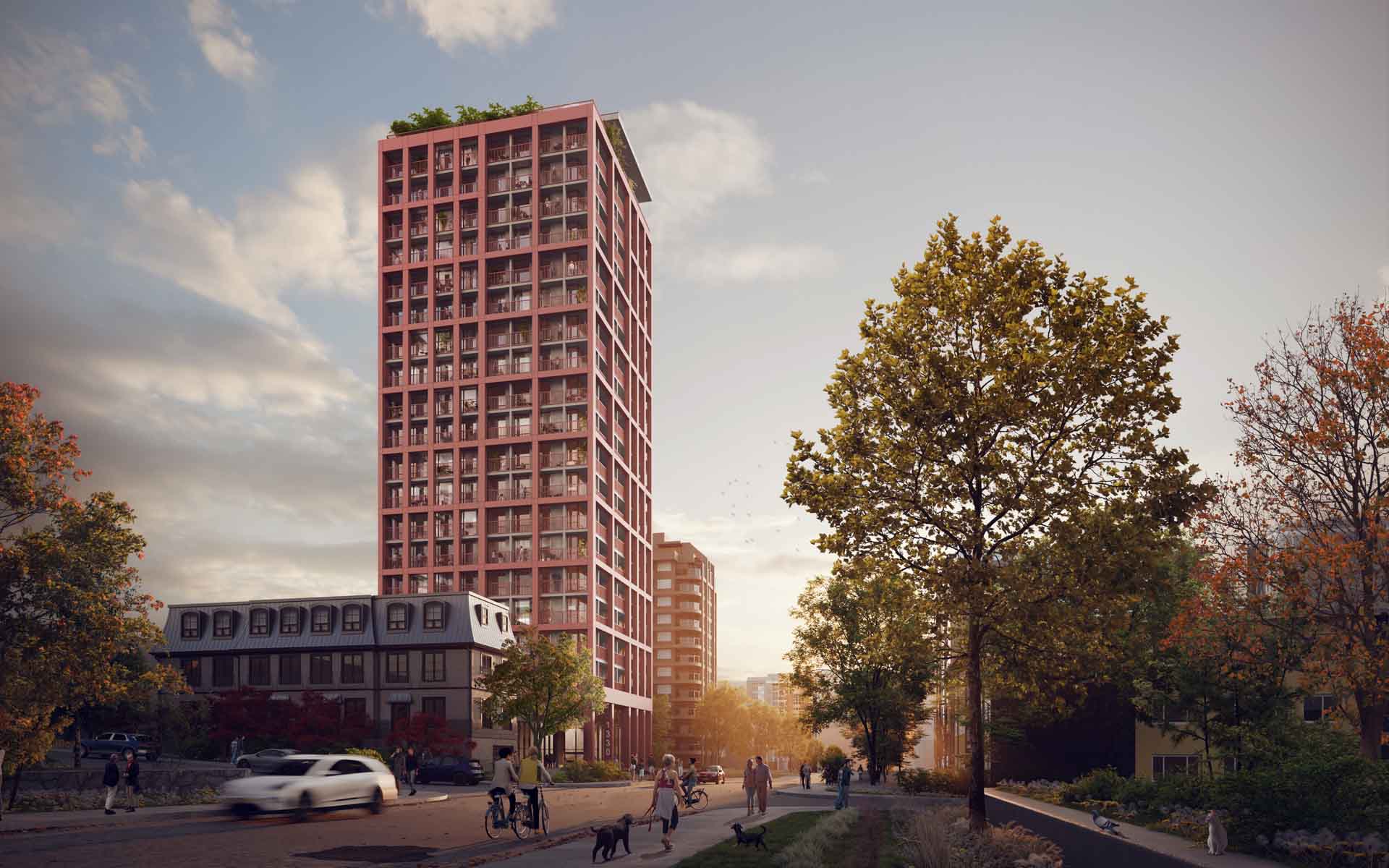
Fairview Tower in Vancouver, Canada / Architect: Faulkner Browns Architects / Real estate rendering created by RNDR
Work with Our European 3D Visualization Studio on Your Next Toronto Development
Whether you are a developer preparing a pre-sales campaign, an architect presenting to a planning committee, or an interior design firm pitching a commercial space fitout, the visual quality of your project presentations shapes how people respond to the work.
Our 3D studio creates renderings that do not just document of a design. They make an argument for it. If you are working on new developments in Toronto and want to talk through what lifestyle renderings could do for your project, we are easy to reach and direct to work with.
Send us your project brief and let’s build a better future together.
Frequently Asked Questions – FAQ
How does 3D architectural rendering services actually help urban planners catch problems before ground breaks?
You can argue with a rendering in a way you cannot argue with a drawing. When a 3D visualization shows a tower casting a three-hour shadow across a public plaza, that conversation happens in the planning room, not on site. Digital twins take this further by staying active after construction ends, giving facility managers a live model to reference for maintenance, phasing, and future modifications. Problems identified at the visualization stage cost a fraction of what they cost once concrete is poured.
Do luxury properties over $1M CAD actually need high-quality 3D renderings and animation in Toronto, or is it just a nice extra?
For high-end properties, animation is not a production upgrade. It is the difference between a buyer imagining a space and feeling like they already live in it. Static renders show what a design excellence of their future penthouse looks like. Animation shows how morning real world lighting moves through a double-height living room, how the terrace connects to the interior, how the building sits above the city. Buyers spending over a million CAD are not making decisions from floor plans. They are buying an experience before it exists, and 3D renderings and animation is how you sell that honestly.
How do lifestyle renderings and virtual tours actually speed up real estate sales?
A physical show suite puts one buyer group in a room at a time. A virtual tour runs simultaneously for investors in Seoul, Toronto, and London without anyone booking a flight. Lifestyle renderings do the emotional work that floor plans cannot: they show a kitchen being used, a balcony worth waking up for, a lobby that feels like somewhere. Pair that with real-time cloud workflows and the team can push updated stunning visuals of a design change, keeping marketing materials accurate without halting the sales campaign.
Does 3D architectural rendering in Toronto handle zoning compliance and material production?
Daylight and shadow studies generated from the 3D model can be run against specific zoning requirements, showing setback compliance, shadow impact on neighbouring properties, and solar access across seasons. That is documentation a planning committee can actually evaluate.
On the production side, AI-assisted texturing has cut material preparation time significantly. What used to take a day of manual work now takes hours, and the output is more consistent across scenes. The result is photorealistic images that are both visually accurate and technically defensible.